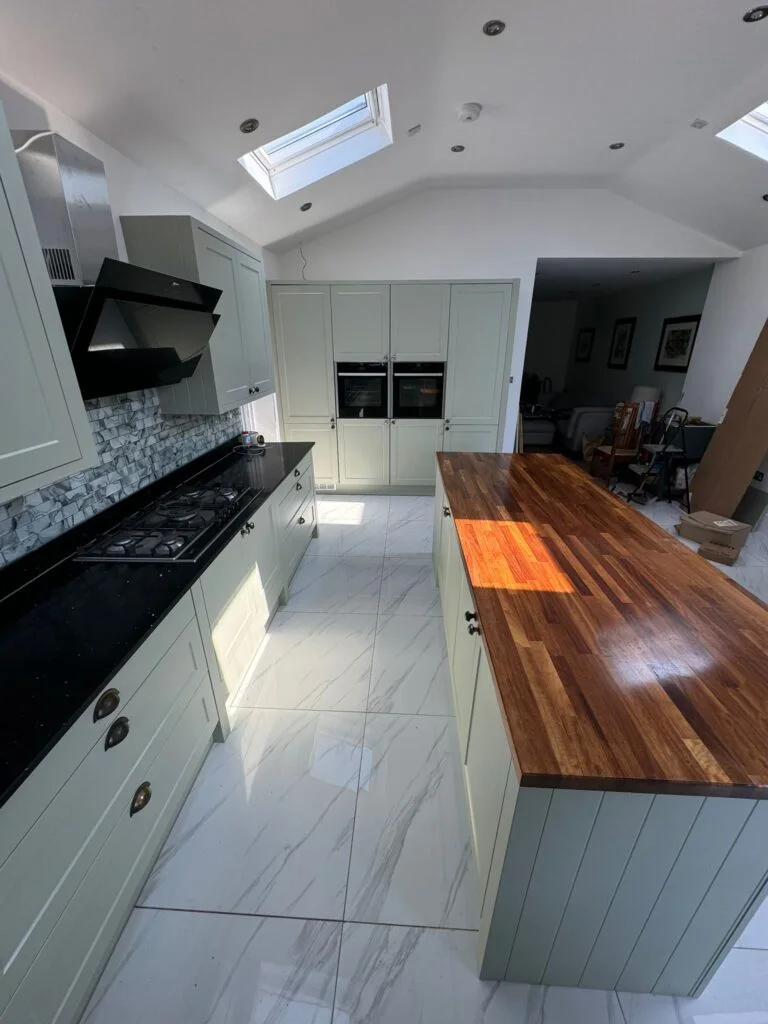
At kitchen handover, walk through the agreed work with the installer, operate the doors and drawers, inspect the visible finish and record anything outstanding. Collect product instructions and relevant certificates. A written snagging list should say what needs attention, who owns the task and how the follow-up will be arranged.
This is a homeowner’s check of the finished result. It does not replace electrical testing, specialist commissioning or other professional checks. Ask the responsible trades for the documentation appropriate to their work.
Compare the kitchen with the agreed scope
Have the final drawing, quotation and approved changes available. Start by confirming that the supplied and fitted items match what was agreed. If something differs, establish whether it was an authorised change, a temporary arrangement or an outstanding task.
Separate incomplete items from faults. A missing replacement panel may already have a supplier reference and expected delivery date. Recording that information is more useful than adding a vague note saying “finish panel”.
Walk the room in ordinary light as well as under the new kitchen lighting. Do not leave the whole discussion until the installer is packing away and everyone is trying to get out of the door.
Open doors, drawers and pull-outs
Use each item normally. Look for catching, rubbing, unexpected resistance or collision with neighbouring handles and walls. Check integrated appliance fronts through their intended movement, following any instructions given by the installer.
Ask for demonstrations of unfamiliar hinges or internal mechanisms. A fitting that works differently from your old kitchen may need explanation rather than adjustment. Do not force it to find out.
Record the position of a problem on the plan or with a labelled photograph. “Drawer beside oven catches” gives the installer a clear task. A long list of unlabelled close-up images can be difficult to locate in the room.
Inspect visible surfaces and junctions
Look at worktop joins, exposed edges, panels, plinths and the agreed wall finish. Check the areas around the sink and tap for obvious issues during the installer’s demonstration. Raise anything unexpected without trying to dismantle or repair it yourself.
Judge the result against the agreed specification and product characteristics. Ask the supplier or installer about a mark or variation you do not understand. A pattern change in a material and accidental damage may need different responses.
If some decoration or tiling is excluded, record where the fitter’s work ends and the next person’s task begins. That avoids treating an agreed unfinished area as a disputed defect later.
Confirm operation and service access
Ask the relevant installer to demonstrate appliances and explain the accessible isolation or service points. Keep their instructions with the product manuals. Do not remove covers or test electrical or gas connections yourself.
Check that you know how to remove filters for cleaning and where maintenance access has been left. Ask how an integrated appliance would come out for repair, especially where finished flooring meets its opening.
If anything cannot be commissioned yet, record why and who will return. An appliance being physically in place is not the same as confirmation that it is ready to use.
Gather the documents in one place
Keep the following as applicable to the agreed work:
- The final plan, fitting quotation and approved changes.
- Appliance model references, manuals and receipts.
- Worktop identity, care instructions and supplier contact.
- Relevant electrical, gas or other specialist documentation.
- Product and installation aftercare details.
- Warranty registration instructions and any deadlines.
Ask who has completed registrations and which remain your responsibility. Do not assume that buying or installing a product automatically completes every administrative step.
Give every outstanding item an owner
A useful snag record has the location, description, photograph if needed, responsible person and next action. Agree how updates will be communicated and when to follow up if a replacement is delayed.
Keep payment discussions tied to your actual agreement rather than treating a generic checklist as a contract. The purpose here is a clear record of the work and remaining tasks.
Use the interactive checklist below during the walk-through. It stays on this page and is not sent to the installer. For a new Watford-area project, speak to Dan about fitting and include handover and aftercare questions in the quotation discussion.